Biotin vs. Collagen for Scalp Regeneration
Walk into any health food store and you’ll find biotin and collagen marketed side by side as the definitive solution to thinning hair and a weakened scalp. Both are legitimate, science-backed supplements — but they work through entirely different mechanisms, target different parts of the hair-scalp system, and are suited to different people and goals. This guide cuts through the marketing and gives you a clear, evidence-based answer: what each does, where the evidence actually stands, and which one — or combination — is right for your specific situation.
The Keratin Infrastructure Vitamin
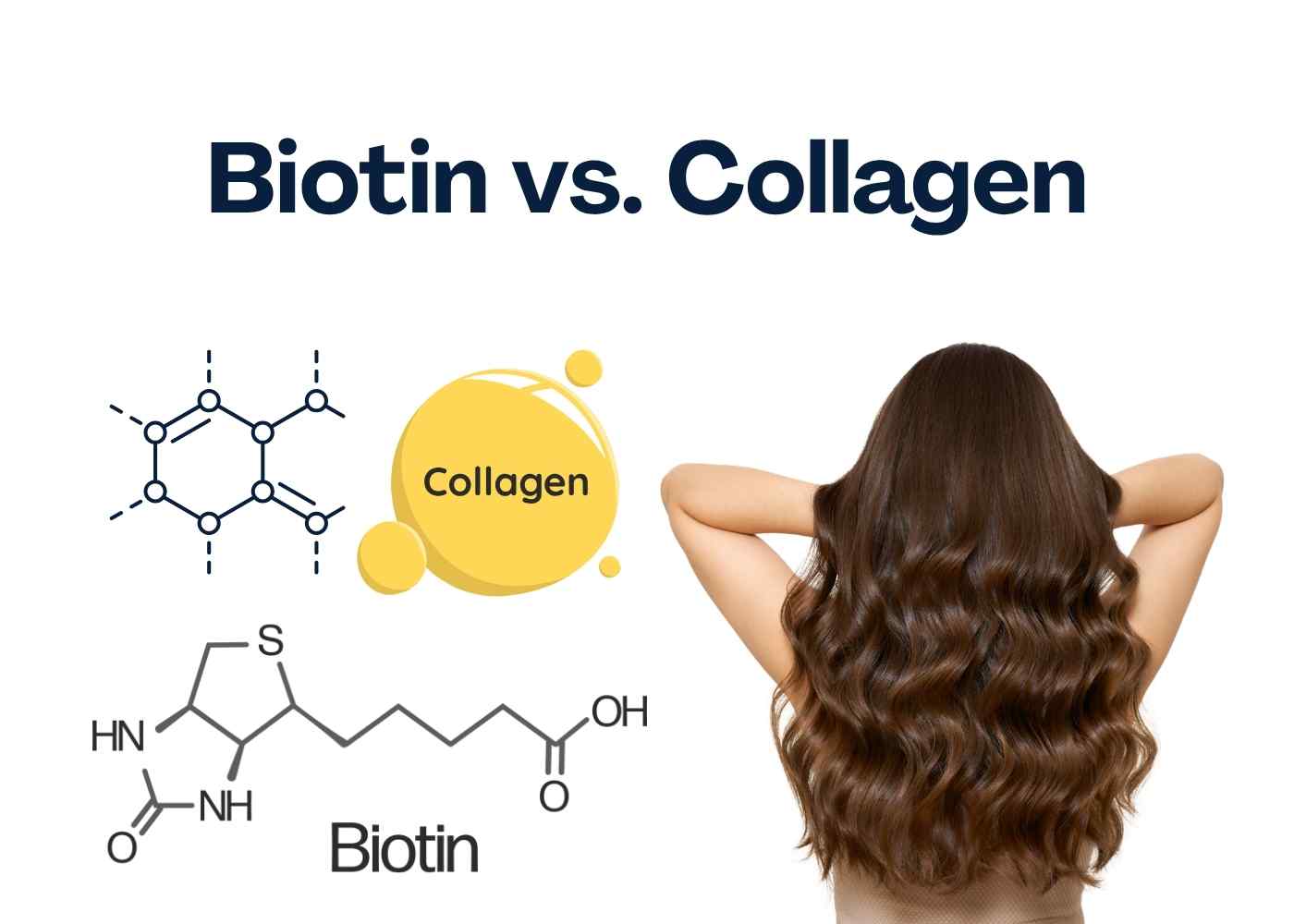
Biotin is a water-soluble B vitamin (B7) that acts as a coenzyme in several critical metabolic pathways — most relevantly, the carboxylation reactions involved in fatty acid synthesis and amino acid metabolism. For hair specifically, biotin is required for the synthesis of keratin — the fibrous structural protein that makes up approximately 95% of the hair shaft.
- Functions as a coenzyme for 5 carboxylase enzymes involved in macronutrient metabolism
- Required for the conversion of amino acids into the building blocks of keratin
- Supports fatty acid synthesis — important for scalp sebum balance and barrier function
- Involved in cell signalling pathways that regulate hair follicle cycling
- Water-soluble — excess is excreted; toxicity is essentially unknown at supplemental doses
Here is where honest reporting diverges from supplement marketing. The clinical evidence for biotin supplementation improving hair health is compelling — but only in people who are actually deficient. In people with normal biotin levels, supplementation has not been shown to improve hair growth, thickness, or shedding in well-controlled studies. This perspective is supported by BBC Food’s analysis of hair-healthy nutrients, which emphasizes that while specific vitamins like Biotin are essential for keratin production, they are most effective when integrated into a balanced, whole-food diet rather than taken in isolation as high-dose supplements.
However, biotin deficiency is more common than widely recognised. Populations at elevated risk include: people consuming raw egg whites regularly (avidin in raw egg whites binds biotin and blocks absorption), those with inflammatory bowel disease or Crohn’s disease, people on long-term antibiotic use (which disrupts gut bacteria that synthesise biotin), individuals who have had bariatric surgery, pregnant and breastfeeding women, and people on anti-epileptic medications including valproic acid.
In people with confirmed deficiency, biotin supplementation produces dramatic and rapid improvement in hair and nail quality — often within 3–6 months. This is why biotin has such a strong anecdotal reputation: those who benefit from it are those who needed it most, and the improvement is genuinely striking.
The Scalp Foundation Protein
Collagen is the most abundant protein in the human body, comprising approximately 30% of total protein mass. It is the primary structural component of the dermis — the layer of skin directly beneath the epidermis, and the layer in which hair follicles are anchored. For scalp health, collagen provides the scaffolding that holds follicles in place, maintains scalp elasticity, and ensures adequate blood vessel integrity for follicular nutrient delivery.
- Type I collagen is the dominant type in scalp dermis — provides tensile strength and structure
- Type III collagen provides elasticity and is particularly important in the perifollicular (around follicle) matrix
- Collagen production declines approximately 1% per year after age 25
- Collagen fibres surround and anchor each hair follicle in the dermis
- Supports the integrity of blood vessel walls supplying the scalp
- Acts as an antioxidant — collagen peptides scavenge free radicals that damage follicular DNA
The term “scalp regeneration” most accurately refers to the renewal of the dermal environment in which follicles reside — and this is precisely where collagen has its most direct impact. As the scalp ages, or when it is subjected to chronic inflammation, UV damage, or hormonal changes, the collagen matrix surrounding follicles degrades. This degradation loosens the anchoring of follicles, reduces the mechanical support that signals follicles to remain in the growth phase, and impairs the microcirculation that keeps follicles nourished.
Hydrolysed collagen peptides — the form used in supplements — are broken down into small amino acid chains (particularly hydroxyproline) that are absorbed and transported to the dermis, where they stimulate fibroblasts to produce new collagen. This is not simply replacing lost collagen directly; it is triggering the body’s own collagen synthesis machinery.
“Biotin feeds the factory that makes hair. Collagen reinforces the building that the factory operates in. Both matter — but they are not interchangeable.”
| Factor | Biotin | Collagen |
|---|---|---|
| Primary target | Keratin synthesis inside the hair follicle | Dermal matrix and perifollicular scaffolding |
| Mechanism | Coenzyme in amino acid and fatty acid metabolism | Stimulates fibroblast collagen production in dermis |
| Who benefits most | Those with confirmed or likely deficiency | Anyone over 25; post-inflammatory scalp; ageing scalp |
| Evidence quality | Strong for deficient individuals; weak for normal levels | Moderate-to-strong for scalp/skin; growing body of RCTs |
| Typical dose | 1,000–5,000 mcg/day (mcg, not mg) | 5,000–10,000 mg/day hydrolysed peptides |
| Time to results | 3–6 months (if deficient) | 3–6 months for skin/scalp changes; longer for hair |
| Safety profile | Excellent — water-soluble, excreted if excess | Excellent — well-tolerated; minor GI effects at high doses |
| Scalp-specific benefit | Sebum regulation; keratin quality | Scalp elasticity; follicle anchoring; antioxidant protection |
| Works without deficiency? | Limited evidence — unlikely to help if levels are adequate | Yes — collagen declines with age regardless of diet |
Prioritise biotin supplementation if any of the following apply to your situation:
- Your diet is restricted: Vegans, vegetarians, and people on highly restrictive diets are at elevated risk of marginal biotin deficiency — particularly if gut health is compromised.
- You regularly eat raw eggs: Avidin in raw egg whites binds biotin with very high affinity, preventing its absorption. Even 2–3 raw eggs per day is sufficient to induce deficiency over time.
- You’re on long-term medications: Antibiotics, anti-epileptics (particularly valproic acid), and some cholesterol-lowering drugs impair biotin status.
- Your hair and nails are brittle simultaneously: Brittle nails combined with brittle, easily broken hair is a classic presentation of biotin deficiency. Healthy hair with brittle nails (or vice versa) is less suggestive.
- You’ve recently had gut surgery or have IBD: Biotin absorption is significantly impaired by conditions affecting the small intestine.
- You’re pregnant or breastfeeding: Requirements increase substantially during pregnancy; deficiency is common in the third trimester even in well-nourished women.
Prioritise collagen supplementation if any of the following apply:
- You are over 30: Collagen production declines from approximately age 25 onwards. By age 40, most people have lost 10–20% of their peak dermal collagen. This is age-related and universal — not a deficiency in the clinical sense, but a genuine reduction that supplementation can partially offset.
- Your scalp has lost elasticity or feels thin: A scalp that feels tight, thin, or “papery” reflects underlying dermal collagen loss. This directly affects follicular anchoring and blood supply.
- You’ve had prolonged scalp inflammation: Chronic inflammation from seborrheic dermatitis, psoriasis, or contact dermatitis degrades the perifollicular collagen matrix. Collagen supplementation supports repair of this damage.
- Your hair is thinning diffusely with age: Age-related diffuse thinning often reflects both hormonal changes and dermal collagen loss — collagen addresses the structural component of this process.
- You’ve had a hair transplant: The post-transplant recovery period involves significant dermal remodelling. Collagen supplementation from month 3 onwards supports this remodelling and may improve graft environment quality. See our post-transplant care guide.
- You want antioxidant protection for follicles: Collagen peptides have demonstrated free radical scavenging activity, protecting follicular cells from oxidative DNA damage — a mechanism relevant to both hair loss prevention and scalp ageing.
High biotin demand during pregnancy; postpartum telogen effluvium is common
Biotin priorityAge-related collagen decline + hormonal changes driving gradual density loss
Collagen priorityBiotin deficiency risk elevated; dietary collagen is absent from plant-based diets
Both — different reasonsDermal remodelling phase; collagen supports graft environment recovery
Collagen priorityInflammation degrades perifollicular collagen matrix; stress depletes biotin
Both beneficialAntibiotics, anti-epileptics impair biotin; collagen unaffected by most medications
Biotin priorityYes — and for many people, this is the most rational approach. Because biotin and collagen work through entirely different and complementary mechanisms, there is no antagonism between them. They do not compete for the same receptors, pathways, or metabolic resources.
A practical combined protocol for scalp regeneration:
- Biotin: 1,000–2,500 mcg per day with food (higher doses offer no additional benefit unless deficiency is severe)
- Hydrolysed collagen peptides: 5,000–10,000 mg per day — most conveniently taken as a powder mixed into coffee, smoothies, or water
- Vitamin C alongside collagen: Vitamin C is a required cofactor for collagen synthesis. Take 200–500 mg of vitamin C at the same time as your collagen supplement to maximise bioavailability
- Zinc alongside both: Zinc is required for both keratin synthesis (supporting biotin’s role) and collagen cross-linking (supporting collagen stability). 15–25 mg/day from food or supplements
Setting realistic expectations is essential. Neither supplement is a standalone treatment for significant hair loss conditions. Specifically:
- Neither addresses androgenetic (pattern) hair loss directly: DHT-driven follicle miniaturisation requires DHT-blocking interventions (finasteride, saw palmetto, minoxidil). Biotin and collagen support the follicular environment but do not inhibit DHT.
- Neither reverses established scarring alopecia: Once follicles are replaced by scar tissue, no nutritional supplement can regenerate them.
- Neither replaces a nutrient-rich diet: Supplements fill gaps in an otherwise adequate diet. Poor overall nutrition — particularly inadequate protein, iron, and zinc — will undermine hair health regardless of biotin or collagen supplementation. See our guide on protein and hair keratin production and iron deficiency and scalp thinning.
- Neither works quickly: Hair has a slow growth cycle. Even if a supplement is working, visible results take a minimum of 3–6 months. Abandoning a supplement after 4–6 weeks because “nothing is happening” is the most common reason people conclude it doesn’t work.
The Bottom Line
Biotin and collagen are both legitimate, well-tolerated supplements with meaningful roles in scalp and hair health — but they are not interchangeable, and they are not equally necessary for everyone. Understanding the difference determines whether you supplement smartly or spend money on something your body doesn’t need.
Key principles:
- Biotin helps if you’re deficient — it supports keratin synthesis from within the follicle
- Collagen helps almost everyone over 25 — it rebuilds the dermal scaffolding follicles depend on
- They are complementary, not competing — combining both is rational for most people
- Always take collagen with vitamin C — it is required for collagen synthesis
- Neither addresses DHT-driven pattern hair loss — that requires a different approach
- Give any supplement at least 3–6 months before assessing efficacy
The best supplement is the one your specific scalp actually needs — not the one that’s most aggressively marketed.
Scalp Health for Men: Early Thinning Prevention
Targeted strategies and routines to maintain hair density and prevent premature loss.
Read Article → NutritionHair Keratin Production & Scalp Health
How protein intake and specific amino acids fuel the building blocks of your hair.
Read Article → MedicalIron Deficiency and Scalp Thinning
Understanding the vital link between ferritin levels and follicle regeneration.
Read Article →